
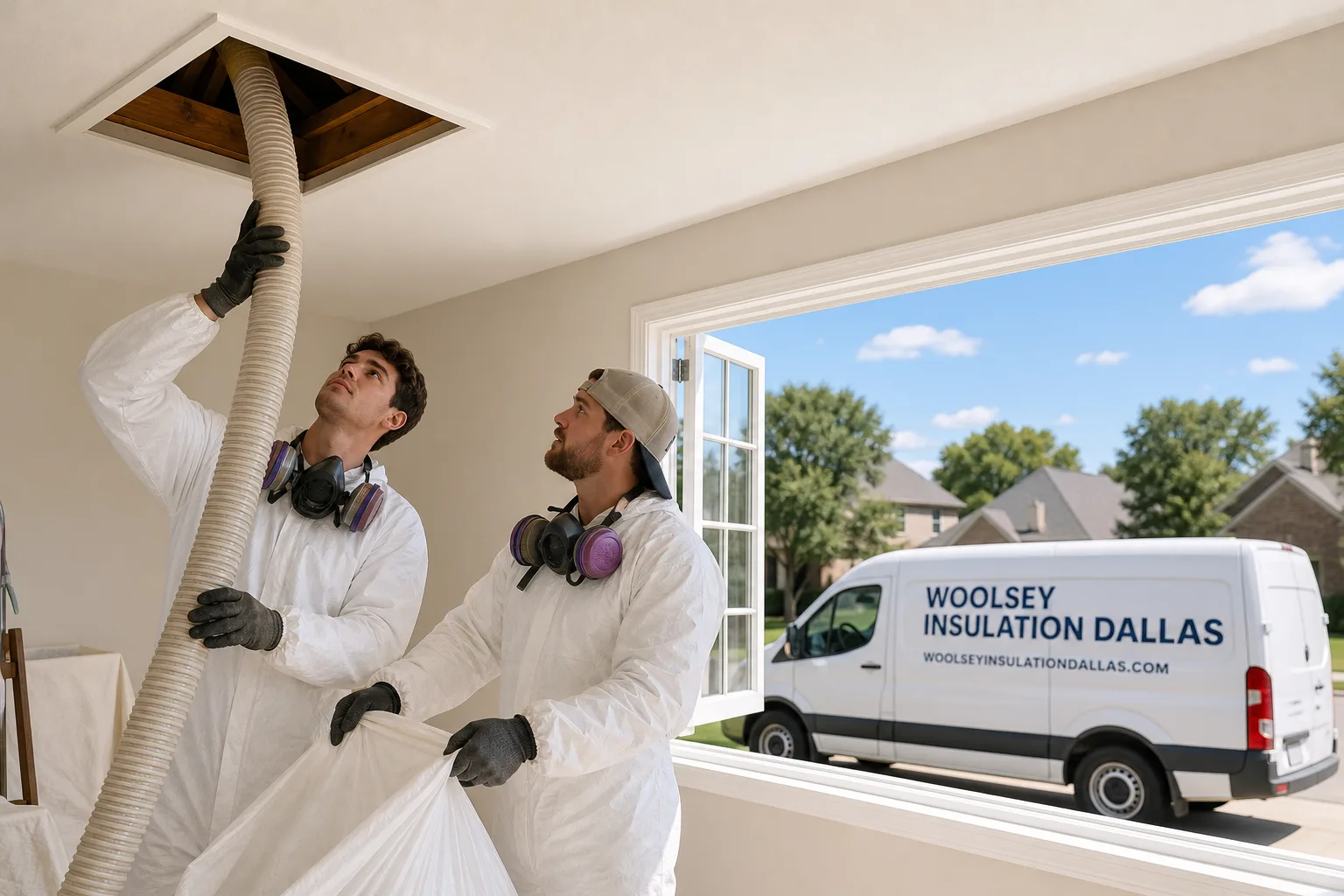
How Much Does Wall Insulation Cost in Dallas?
Wall insulation in Dallas typically costs between $1.50 and $4.50 per square foot installed, with most homeowners spending $1,800 to $6,200 for a full exterior wall retrofit on a 1,500 to 2,000 square foot home. Blown-in cellulose and fiberglass batts land on the lower end of that range, while spray foam runs higher because it seals and insulates in a single step. We give every homeowner a written price before any work starts, so the number you see is the number you pay.
Here’s something most price guides won’t tell you: Dallas homes built before 1980 often have zero insulation in the walls. Builders in that era counted on the attic alone, which is why so many older homes in Lakewood, Casa View, and Richardson feel drafty in February and bake by July. If you’re in that situation, wall insulation isn’t a comfort upgrade, it’s a repair that’s overdue.
Wall Insulation Cost Breakdown (2026)
These are real ranges from the Dallas market in 2026, not national averages. They include labor, materials, and the standard prep work for each method.
| Insulation Type | Cost Per Square Foot (Installed) | Typical 2,000 Sq Ft Home (Exterior Walls Only) | Best For |
|---|---|---|---|
| Fiberglass batts (R-13 to R-15) | $1.50 – $2.75 | $1,900 – $3,900 | Open stud cavities during renovation |
| Blown-in cellulose (R-13 to R-19) | $1.75 – $3.25 | $2,200 – $4,600 | Retrofit into finished walls |
| Blown-in fiberglass (R-13 to R-19) | $1.60 – $3.00 | $2,000 – $4,250 | Retrofit, slightly lower cost than cellulose |
| Open-cell spray foam (R-3.7 per inch) | $2.25 – $3.75 | $3,100 – $5,300 | Remodeling, sealing air gaps |
| Closed-cell spray foam (R-6.5 per inch) | $3.00 – $4.50 | $4,200 – $6,200 | Maximum R-value per inch, moisture barrier |
Those numbers assume accessible wall cavities. If your walls are finished and you’re not planning to tear out drywall, the job usually means drilling small access holes from the outside or inside, blowing in loose insulation, and patching. That’s the most common wall insulation job we do in Dallas, and it lands in the $2,000 to $5,500 range for an average home, depending on the material and the condition of the siding or stucco.
New construction is different. We install wall insulation before drywall goes up, which is faster and cheaper per square foot because there’s nothing to drill through or patch. For builders and homeowners doing a full gut renovation, fiberglass batts or open-cell spray foam are the most common choices in the Dallas market.
What Affects Wall Insulation Pricing in Dallas
No two homes in Dallas insulate the same way. Here’s what actually moves the number.
- Wall construction and accessibility. Stucco exterior walls, common in East Dallas and older parts of Oak Cliff, are more expensive to drill and patch than vinyl siding or brick veneer. Brick veneer is easier to work with if we can access the wall cavity from inside, but that means patching drywall instead.
- Age of the home. Homes in neighborhoods like Lakewood, M Streets, and Kessler Park were often built with zero wall insulation. Retrofitting them means drilling through plaster or original siding, which takes more care and time than working on a 1990s frame house.
- Insulation material. Blown-in cellulose is the workhorse for retrofit jobs in Dallas because it costs less and fills irregular cavities well. Spray foam costs more per square foot but delivers a higher R-value per inch and seals air leaks at the same time, which matters in Dallas where summer humidity and winter wind push air through every gap.
- R-value target. The Department of Energy recommends R-13 to R-15 for walls in our climate zone, but some homeowners in Dallas go to R-19 or R-21, especially on west-facing walls that absorb afternoon sun. Higher R-value means more material and a higher price.
- Square footage of exterior wall area. This is not the same as your home’s square footage. A 2,000-square-foot home with 8-foot ceilings has roughly 1,400 to 1,800 square feet of exterior wall to insulate, and that’s the number that drives cost.
- Obstructions inside the walls. Older homes have fire blocking, cross bracing, and electrical runs that slow down blown-in work. Dallas homes rewired in the 1970s and 1980s often have junction boxes in unexpected places, and the crew has to work around them carefully.
How Wall Insulation Works in a Dallas Climate
Dallas gives walls a workout that most of the country never experiences. Highs above 100°F in July and August, humidity that hovers near 70%, and the occasional hard freeze in January mean your exterior walls face a 70-degree temperature swing across the year. Wall insulation slows heat transfer through those walls in both directions: keeping the air-conditioned air in during summer and the heated air in during winter.
What most Dallas homeowners don’t realize is that wall insulation is also a major piece of the humidity puzzle. When hot, humid outdoor air leaks through an uninsulated wall cavity, it hits the cool interior drywall and condenses inside the wall. That’s a slow, invisible problem that leads to mold, mildew, and rotting studs. Closed-cell spray foam is especially effective here because it acts as both an insulator and a moisture barrier, and it’s a common choice in Dallas homes with stucco exteriors that trap moisture against the wall sheathing.
Wall Insulation and Air Sealing: Why They Go Together
Insulation slows heat transfer. Air sealing stops air movement. They’re different problems, and Dallas homes often need both addressed at the same time. If you blow insulation into an unsealed wall cavity, it fills the space but air still moves through the gaps around outlet boxes, baseboards, and the top and bottom plates where the wall meets the floor and ceiling.
A proper wall insulation job in Dallas includes air sealing at the critical points: the rim joist where the wall sits on the foundation, the top plates where the wall meets the attic, and any penetrations in the wall itself. That’s a standard part of how Woolsey approaches wall insulation, because insulation without air sealing cuts the performance roughly in half. You’re paying for the material either way, so it should work as hard as it can.
How the Kingswell Way Applies to Wall Insulation
Every wall insulation job Woolsey does in Dallas follows the same five-step process, which we call the Kingswell Way. We say the price before anything is touched. We show up in the window we committed to. We leave the job site cleaner than we found it. We put the guarantee in writing. And if the work fails, we come back at no charge.
That guarantee is specific: 365 days, in writing, included on every job. Not a verbal promise. Not a “we’ll see what we can do.” If the insulation doesn’t do what we said it would do within a year, we fix it at our cost. Glenn Hartley, who leads Woolsey Insulation Dallas, started with the idea that a guarantee should mean something in this trade. We still run the company that way.
Real Jobs, Real Numbers
Here’s what a few typical wall insulation projects in Dallas look like.
Finished exterior walls in a 1950s brick ranch, Casa View
1,600 square feet of exterior wall, no existing insulation, brick veneer exterior. We drilled from the inside, blew in R-13 cellulose, and patched drywall. Total job: $3,100. That included air sealing around the top and bottom plates and a full cleanup. The homeowner saw their July electric bill drop by roughly $90 the first month.
Open stud walls during a kitchen and living room remodel, Lake Highlands
The contractor opened the exterior walls for rewiring and plumbing. We came in behind the electrician and installed R-15 fiberglass batts before the drywall went back up. About 450 square feet of wall. Total: $1,050. The contractor said it was the cleanest insulation install he’d seen in 20 years, and we still hear from that homeowner every time a neighbor asks about insulation.
Full spray foam wall retrofit, M Streets
A 1938 home in the M Streets with original plaster walls and no insulation. The homeowner wanted to keep the plaster and avoid tearing out anything. We drilled small holes, injected closed-cell spray foam, and patched. 1,200 square feet of exterior wall. Total: $5,400. The hardest part was working around the original framing, which is true timber, irregularly spaced, and full of surprises. Closed-cell foam handled the odd cavities better than batts or blown-in could have.
Blown-in fiberglass in a 1990s frame house, Richardson
The home had R-11 batts from the original build, which had slumped and settled over three decades. We extracted the old batts where possible and dense-packed R-15 fiberglass. 1,800 square feet of wall. Total: $4,150. The homeowner reported the house held temperature noticeably better that winter, especially in the north-facing bedrooms.
What Wall Insulation Does to Your Dallas Utility Bill
The honest way to think about wall insulation is not as an upfront expense but as a monthly return. The Department of Energy estimates that air leaks and under-insulated walls account for 25% to 40% of the energy a typical home loses. In Dallas, where the AC runs from May through October, that translates directly into kilowatt-hours on your Oncor or CoServ bill.
For a 2,000-square-foot home with no wall insulation, adding R-13 to R-15 typically cuts annual heating and cooling costs by 15% to 20%. On a $250 average monthly summer electric bill in Dallas, that’s $35 to $50 a month during the cooling season alone. Over a year, most homeowners save $400 to $900, which means the job pays for itself in four to eight years, faster if you combine wall insulation with a properly insulated attic.
But the savings story is more than dollars. An uninsulated wall means hot surfaces inside your home even when the AC is running. You can feel the difference standing next to an exterior wall in August. After insulation, that wall is close to room temperature, and the house feels stiller, quieter, and more comfortable without cranking the thermostat down.
Wall Insulation and Home Value in Dallas
Insulation rarely comes up in home listings, but it shows up in the buyer’s lived experience. A house that holds temperature, feels quiet, and doesn’t leak air leaves an impression. We’ve worked with Dallas realtors who tell us that energy improvements like insulation are one of the few upgrades that buyers notice without being told about.
If you’re planning to sell in the next few years, adding wall insulation can be a competitive edge in a Dallas market where much of the housing stock is 40 to 70 years old and under-insulated. But if you’re staying, the calculation is simpler: you’re paying the utility company to keep the outside air outside, and right now you’re overpaying.
How Wall Insulation Fits With Attic Insulation
Heat moves through a house in two main directions: up into the attic in winter, and in through the walls and roof in summer. Attic insulation handles the rising heat. Wall insulation handles the heat coming through the sides. If you do one without the other, you’re only solving half the problem.
In Dallas, attic insulation is often the bigger priority because it’s less expensive and delivers a faster payback. But if your attic is already insulated and your walls are not, the walls become the weak point. We regularly see homes in North Dallas with R-38 or R-49 in the attic and empty wall cavities. The attic was done, the walls were skipped, and the house still runs hot every afternoon because the sun beats on the walls all day.
Woolsey is first and foremost an attic insulation and spray foam specialist, which we say because we don’t pretend to handle every trade. But wall insulation is part of our core work, and we’ll tell you if your attic and walls both need attention, or if one is more urgent than the other. Learn more about our wall insulation services in Dallas or return to our home page to see everything we handle.
The Eight Brands We Install, and Why That Matters
Woolsey works with eight leading insulation brands: Owens Corning, Johns Manville, Knauf, Rockwool, CertainTeed, Icynene, Demilec, and GreenFiber. That’s not marketing language. It means when we walk into a Dallas home and see what the walls actually look like, we can recommend the material that fits the home, not whatever happens to be on the truck that day.
Different brands have different strengths. Owens Corning and Johns Manville make excellent fiberglass products, both batts and blown-in. Knauf and CertainTeed are known for their blown-in fiberglass and cavity fill consistency. Rockwool makes a stone wool product that holds up well in damp wall cavities, which matters in Dallas where wall moisture is a year-round concern. Icynene and Demilec are spray foam specialists, and GreenFiber is the leading name in blown-in cellulose made from recycled paper. We’ll tell you which one makes sense for your walls and why, in plain terms, before you spend a dollar.
The Woolsey Name, and Where It Comes From
Wool was the first insulation. Before fiberglass, before foam, before cellulose, people stuffed wool between the studs because it trapped air and slowed heat. Woolsey keeps the idea in the name. We’re not doing anything new; we’re doing the same thing people have always done, with better materials and a better process. That’s it.
Woolsey Attic Insulation has been part of the Kingswell family of independently owned and operated insulation companies since 2002. Glenn Hartley leads the Dallas team. We’re not a national chain and we don’t answer to a corporate office. The only office that matters is the one that answers the phone when you call, 24 hours a day, 7 days a week, with a live person on the other end.
What to Ask Any Dallas Insulation Contractor
Before you sign anything with anyone, here are the questions we’d want answered if it were our house.
- What’s the exact price, in writing, before you start? If they won’t put a number on paper before touching the walls, walk away. Prices that change at the door are a red flag, and they’re common in this trade.
- What R-value am I getting, and how do you know it’s enough? Ask for a specific number, not “it’ll be fine.” The Department of Energy recommends R-13 to R-15 for walls in the Dallas climate zone.
- Do you guarantee the work, and for how long? A one-year guarantee in writing is reasonable. A guarantee that lasts as long as the insulation is a sign of real confidence. Ask specifically what happens if the work fails.
- Will the crew be background-checked? You’re letting strangers into your home. A reputable company checks everyone who walks through the door, and every Woolsey technician on a Dallas job is background-checked and uniformed.
- Who do I call if something goes wrong? If the answer is a voicemail box, keep looking. Woolsey has a live person answering the phone 24 hours a day, 7 days a week. Try us at 2 a.m. if you want. Someone will pick up.
How to Save on Wall Insulation in Dallas
Wall insulation is a material and labor job, and you can’t really cut corners on either without paying for it later. But there are ways to keep the bill honest.
- Combine wall and attic insulation in one job. The crew is already on site, the equipment is already set up, and you’ll see savings from both projects sooner. It’s the most efficient way to insulate a Dallas home.
- Do the prep work yourself if you’re handy. Move furniture away from exterior walls, clear the perimeter outside, and mark any wall areas you want the crew to avoid. Every hour you save the crew is an hour you’re not paying for.
- Insulate during a remodel, not as a separate project. If the drywall is already coming down, the expensive part of wall insulation (the access) is free. The difference between batts in open studs and blown-in through drilled holes can be $1,500 or more on an average house.
- Ask about material options honestly. If blown-in cellulose will do the job at $1.75 per square foot, don’t pay for spray foam at $3.50 unless you specifically need the higher R-value or the moisture barrier. We’ll tell you what you need and what you don’t, because the price is on paper before anyone starts, and that forces us to be honest.
- Check for utility company rebates. Oncor and some Dallas-area municipal utilities offer rebate programs for insulation upgrades, especially when combined with air sealing. They change by season, so ask when you call, and we’ll point you to the current program.
One thing worth saying plainly: we quote wall insulation in Dallas for free, and the quote is a written number you keep. No deposit, no haggling at the door, no “I need to check with my manager.” Call (469) 916-4622 and we’ll schedule a time to look at your walls, measure them, and give you a price you can hold us to.
Wall Insulation Safety: What We Handle and What We Don’t
Insulation itself is safe when installed correctly, but wall retrofits sometimes interact with wiring, plumbing, and gas lines hidden inside the cavity. That’s one reason we’re careful about what we say and what we do. If a wall cavity has aluminum wiring from the 1960s, we work around it with care and flag it for you. If a gas line runs through an exterior wall, we coordinate the insulation so it doesn’t interfere with the line or its access points.
We don’t touch the wiring, the plumbing, or the gas line itself. That’s not our trade and we won’t pretend otherwise. What we do is insulate the wall without compromising whatever else is in the cavity, and we’ll tell you honestly if something else needs attention before or after we work. That’s part of the Kingswell Guarantee, too: a job done right, without creating a problem somewhere else in the wall.
FAQs – Wall Insulation Cost in Dallas
What’s the typical cost to insulate walls in Dallas?
Most Dallas homeowners pay $1,800 to $6,200 for full wall insulation, depending on the square footage, material, and wall construction. Blown-in cellulose on a 1,500-square-foot home usually lands around $2,200 to $3,900, while closed-cell spray foam on the same house runs $4,200 to $6,200. Call (469) 916-4622 for a written quote on your specific walls, free.
Is it cheaper to insulate walls during new construction or as a retrofit?
New construction is cheaper per square foot, usually $1.50 to $2.75 for fiberglass batts, because there’s no drilling or patching. Retrofitting finished walls costs $1.75 to $4.50 per square foot because the crew has to create access to the wall cavity and repair it afterward. If you’re renovating and the walls are already open, insulate then and save $1,500 or more.
How much does blown-in wall insulation cost in Dallas?
Blown-in wall insulation in Dallas runs $1.60 to $3.25 per square foot installed, with most retrofit jobs landing between $2,000 and $4,600. Cellulose is slightly higher than blown-in fiberglass but fills irregular wall cavities better, which matters in older Dallas homes with hand-framed walls. For an exact number on your house, call (469) 916-4622 and we’ll measure it free.
Can you insulate my walls without tearing out drywall?
Yes, and that’s the most common wall insulation job we do in Dallas. We drill small access holes from the outside or inside, blow in loose insulation, and patch the holes cleanly. Most jobs take one to two days, and the patching is done so you can’t tell where the holes were. Finished walls don’t have to be demolished to be insulated.
How much does spray foam wall insulation cost in Dallas?
Spray foam wall insulation in Dallas costs $2.25 to $4.50 per square foot installed. Open-cell runs $2.25 to $3.75 and is the more common choice for wall cavities, while closed-cell runs $3.00 to $4.50 and adds a moisture barrier, which helps in humid Dallas summers. Spray foam costs more than blown-in, but it seals air leaks and insulates in one step, so it’s the right choice for some walls.
How long does wall insulation last in a Dallas home?
Fiberglass batts last 20 to 30 years before they sag and lose effectiveness, though poor installation can shorten that. Blown-in cellulose and fiberglass hold their position for 30 to 50 years, and spray foam lasts the life of the house. If you’re buying an older Dallas home with original insulation, it’s usually time for a replacement, and a visual inspection will tell us quickly.
How much does it cost to remove old wall insulation in Dallas?
Removal of old, damaged, or pest-contaminated insulation adds $0.75 to $1.50 per square foot to the job. If the walls are already open for renovation, removal is straightforward. If they’re finished, we typically remove the old material through the same access holes we’d use for the new insulation, so the removal and installation happen in one process. For a specific number on removal and replacement, call (469) 916-4622.
Does wall insulation reduce noise between rooms?
Yes, wall insulation reduces sound transmission between rooms and from outside, though it’s not the same as dedicated acoustic insulation. Blown-in cellulose and Rockwool both perform well for sound dampening, and spray foam is decent but not the best acoustic choice. If noise control is a priority, we’ll recommend the material that balances thermal performance and sound reduction for your specific walls.
Get a Written Price on Your Dallas Wall Insulation
You don’t have to guess what wall insulation will cost. You don’t have to sit through a sales pitch. You just need a real number, on paper, before any work starts, and that’s exactly what Woolsey Insulation Dallas gives every homeowner.
Call (469) 916-4622 to schedule a free wall insulation estimate. A real person answers, 24 hours a day, 7 days a week. Glenn Hartley and the Woolsey team will measure your walls, tell you what you need and what you don’t, and give you a written price you can hold us to. Then we show up on time, leave the place cleaner than we found it, and back the work with a 365-day written guarantee. That’s the whole deal.
Pricing reflects the Dallas market as of 2026. Woolsey Insulation Dallas offers free estimates – call (469) 916-4622.
Written by Glenn Hartley, Owner at Woolsey Insulation Dallas, serving Dallas since 2002.
What Our Customers Say
"Insulation job was done well. Scheduling took a little longer than I'd have liked, they were booked out a couple weeks. But once they came it was quick and the house is cozier."
- Felicia Grant"Showed up on time, laid down protection on the floors, and were careful going into the attic. Explained exactly what they were doing and why. House holds its heat so much better now."
- Preston Hale"Drafty old house that never felt comfortable. After the attic and some air sealing it's a different place. On time, clean, and the quote didn't change. Wish I'd done it years ago."
- Dmitri Kozlov