
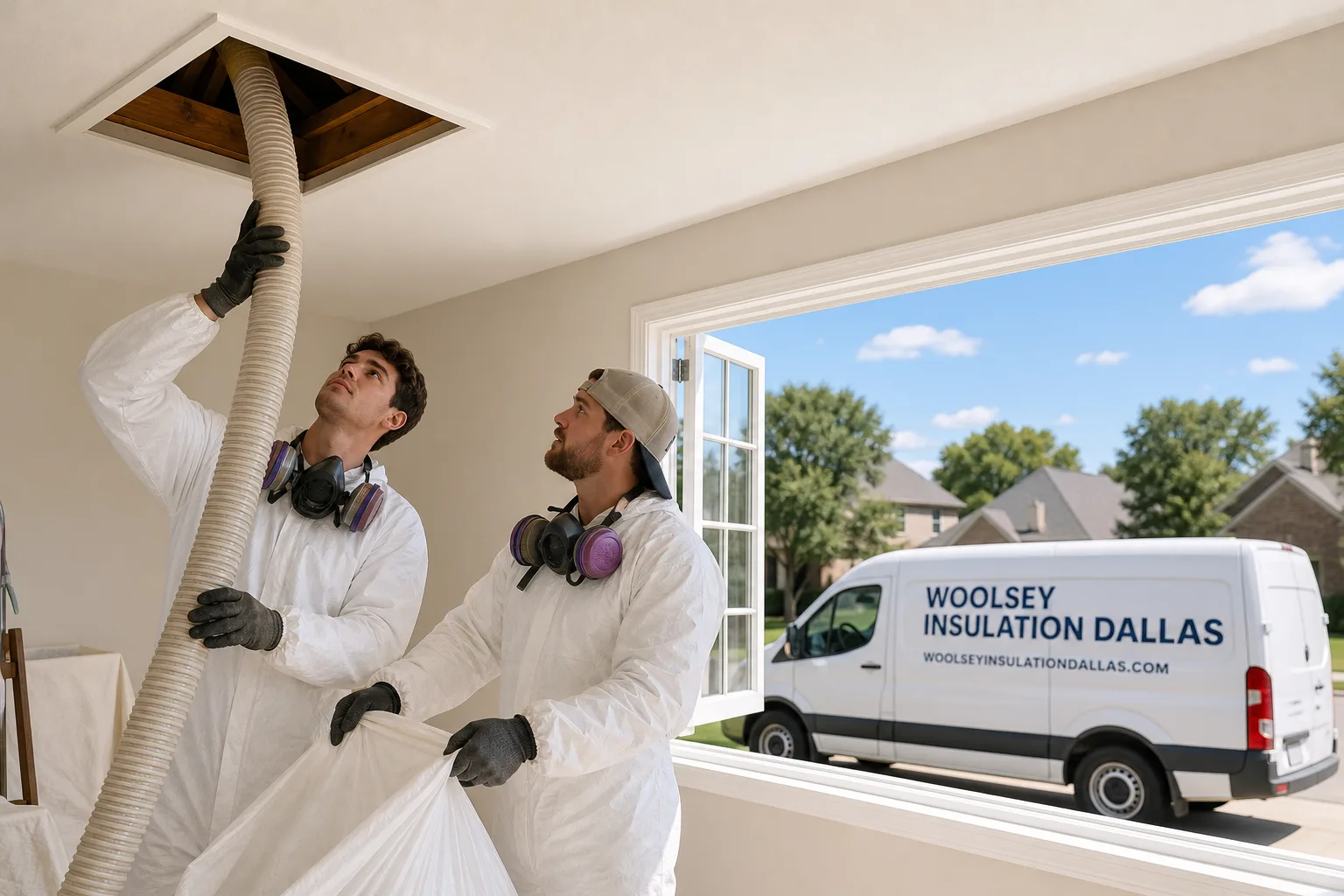
Fast, Reliable Attic Insulation Across Seagoville
Attic insulation in Seagoville typically runs between $2,800 and $6,200 for a full removal and reinstall on a 1,500-square-foot home, with most jobs completed in one day. We’ll give you the exact written number before any work starts, not after we’re in your attic. If you’re tired of sweating through July or watching your heating bill spike every January, call (469) 916-4622 and we’ll walk through what your attic actually needs. Our crews know Seagoville’s older homes well, from the brick-veneer ranchers off Seagoville Road to the pier-and-beam houses near Central Elementary, and we’ve been fixing what the 1970s left behind for years.
Why Woolsey Insulation Dallas Is Seagoville’s Preferred Attic Insulation Company
We’re the Attic Insulation team that treats your attic like it’s our own grandmother’s house. Glenn Hartley leads our crews, and he’s built the Woolsey name on a simple rule: say the price before the work starts, show up when you said you’d show up, and put every promise in writing. Seagoville homeowners tell us the same stories about other contractors: the bid changed at the door, the crew never showed, or nobody returned the call when something failed six weeks later. That’s exactly what the Kingswell Guarantee exists to prevent.
Every job we do in Seagoville gets a written price before the first ladder comes off the truck, a committed arrival window, and a 365-Day Done Right Promise in writing. If the insulation isn’t right within a year, we come back and fix it at no charge. No asterisks, no phone tree. Our technicians are background-checked and uniformed, so you know exactly who’s walking through your door. And when you call at 2 a.m. because a cold snap just hit Seagoville and you feel a draft, a live person answers. Every time. That’s not a marketing line; that’s how we run the business.
We serve Seagoville from our Dallas-Fort Worth dispatch office, with local crews who know the difference between a 1960s tract home off Seagoville Road and a 1990s build near the high school. That local knowledge matters when the problem is settling batts, damp crawl spaces, or rusted roof nails that tell us condensation has been quietly destroying your insulation for years.
Attic Mold Removal in Seagoville
Attic mold removal in Seagoville means pulling out insulation that’s been soaked or contaminated by moisture, treating the affected framing and sheathing, and addressing the source of the damp before new insulation goes back in. Most Seagoville homes we see with attic mold have one thing in common: pier-and-beam foundations sitting on the town’s clay-heavy soil, which holds moisture against the floor system and pushes humid air up into the attic all year. That’s a local pattern, not a generic one.
What Mold Removal Actually Involves Here
The job starts with removing the contaminated insulation, bagging it, and sealing the attic access so spores don’t drift through the house. We then treat the roof decking and framing with an antimicrobial product, dry the space thoroughly, and identify every air pathway that let the moisture in. In Seagoville, that usually means can lights, plumbing chases, and the gaps where the original builder skipped air sealing entirely. We don’t just clean the mold; we make the attic inhospitable to it.
What It Costs in Seagoville
Attic mold removal in Seagoville, including insulation removal and basic treatment, typically runs $1,800 to $4,200 depending on attic size and contamination extent. Full remediation with new insulation and air sealing lands between $4,500 and $8,000 for most local homes. We’ll give you the written number before any work starts, so you’re not surprised by a change order standing in your hallway.
Attic Insulation Removal in Seagoville
Attic insulation removal in Seagoville is the step most 1960s to 1980s homes eventually need, because the original cardboard-backed fiberglass batts have slumped, settled, and lost up to 60% of their rated R-value. Adding new insulation on top of failed insulation doesn’t fix the problem; it just hides it under a fresh layer. We remove everything down to the drywall or plaster, inspect what’s underneath, and start clean.
When Seagoville Homes Need Full Removal
If your attic still has the original batts from when the house was built, or you’re seeing rusted roof nails through the fiberglass, that’s condensation damage from years of moisture cycling. That insulation is doing almost nothing for you. We also remove everything when there’s been a roof leak, a pest infestation, or when a previous homeowner blew new cellulose directly over old batts without addressing the gaps below. The result is the same: a home that can’t hold temperature.
Removal and Replacement Pricing
Attic insulation removal in Seagoville, including disposal and basic attic cleaning, runs $1,200 to $2,800 for most single-family homes. You’ll get the exact number in writing after our first visit, before we remove a single batt. Pair removal with a fresh blow-in install and you’re looking at $3,200 to $6,200 depending on the R-value target and the attic footprint. It’s two separate jobs that almost always happen together, and we price them as one clear line item.
Trusted Brands We Service in Seagoville
We install and service insulation from Owens Corning, GreenFiber, and Demilec, among others, and we pick the material that fits your Seagoville attic rather than whatever happens to be on the truck. GreenFiber cellulose is a workhorse in older Seagoville homes because it fills the odd cavities and shallow truss bays you find in 1960s construction. Demilec and Owens Corning products handle air sealing and high-R-value needs where space is tight. We stock these locally so Seagoville jobs don’t wait on a warehouse shipment, and our crews carry what they need for a one-day removal and reinstall.
Common Attic Insulation Problems We See in Seagoville Homes
- Cardboard-backed fiberglass batts from the 1960s through 1980s that have slumped to half their rated R-value or less. The kraft-paper backing holds moisture against the wood framing, and the fiberglass itself settles and compacts over time, leaving long gaps along the eaves and around framing members.
- Pier-and-beam foundations with damp clay soil driving moisture into the attic year-round. Seagoville’s soil swells when wet and cracks when dry, keeping crawl spaces damp through most springs and falls, and that humidity migrates upward into the attic where it condenses on roof nails and decking.
- Freeze-thaw cycles stressing old, brittle insulation and opening air leaks that lead to frozen pipes and heat loss during sudden winter cold snaps. When temperatures drop into the teens, every unsealed penetration becomes a conduit for cold air to reach plumbing in exterior walls.
- Thermal bypasses around can lights, plumbing chases, and interior walls that were never sealed when the house was built. These gaps allow conditioned air to escape into the attic all summer, and they’re the first place we inspect because they’re the biggest return on investment for almost every Seagoville home we see.
How Seagoville’s Climate and Soil Punish Under-Insulated Attics
Seagoville sits on the Blackland Prairie just southeast of Dallas, and that position shapes every attic problem we walk into. Hot, humid summers push dew points high enough that moisture condenses inside under-insulated wall and ceiling cavities. Winter cold snaps drop temperatures into the teens fast enough to freeze pipes that run through exterior walls. The clay-heavy soil that makes Seagoville’s crawl spaces damp all year adds a third layer: constant moisture migration upward into the attic, where it shows up as rusted roof nails and mold on the sheathing. Most generic insulation guides don’t account for that combination. We do, because we see it on nearly every pre-1990 home in Seagoville. The fix isn’t just more insulation; it’s air sealing first, moisture control second, and then the right material at the right R-value for this specific climate.
Pricing for Attic Insulation in Seagoville, TX
Here’s what Seagoville homeowners can expect to pay for common attic insulation work. A simple attic insulation top-up over existing, functional insulation runs $1,400 to $2,600. Full removal and reinstallation with blown-in cellulose or fiberglass runs $3,200 to $6,200 for most 1,200 to 2,000-square-foot homes. Attic baffles and ventilation prep add $400 to $1,200 depending on the roof geometry. Mold treatment adds $800 to $2,000 to any job where it’s needed. These are real ranges from local work, not national averages. We give you the exact written number before any work starts, and that number doesn’t change at the door. Call (469) 916-4622 for a free estimate and we’ll walk the attic with you, show you what we see, and put the price in writing.
We Also Serve Cities Near Seagoville
Our Seagoville crews also cover homes in Attic Insulation in Seagoville and the surrounding communities of Balch Springs, Dallas, Red Oak, and Rowlett. If you’re just over the line in any of those towns, the same written-price guarantee and the same local knowledge applies. Call (469) 916-4622 and we’ll schedule your attic assessment.
Serving Seagoville, TX - Our Local Coverage Area
We’re based in the Seagoville area and know this community well. Use the map below to see our service coverage - if you’re nearby, we can almost certainly help.
FAQs About Attic Insulation in Seagoville
Because the original insulation in those attics has failed, not just thinned. The cardboard-backed fiberglass batts from the 1960s through 1980s have slumped, settled, and absorbed moisture from the town’s damp crawl spaces. Adding new insulation on top traps that moisture against the old material and hides the thermal bypasses underneath. Removal gives us access to air seal the gaps, inspect for mold and condensation damage, and install insulation that actually performs at its rated R-value. If you blow new insulation over the old in a pre-1990 Seagoville home, you’re paying to cover a problem, not fix it. Call (469) 916-4622 and we’ll tell you exactly what your attic needs.
Clay-heavy soil holds moisture against pier-and-beam foundations, and that moisture migrates upward into the attic year-round. The result is rusted roof nails, damp insulation, and mold growth on sheathing. We address it by sealing the floor system where pipes and wiring penetrate, ensuring crawl space ventilation is working, and choosing insulation materials that don’t absorb and hold moisture the way old fiberglass batts do. Air sealing the attic floor is the most important step, because it cuts off the moisture pathway. This is a Seagoville-specific problem that generic insulation contractors from drier areas often miss entirely.
The biggest mistake is leaving the original insulation in place and simply covering it with new blown-in material. Those homes were built with minimal R-value to begin with, and sixty years of settling, moisture exposure, and pest activity have rendered the original batts nearly useless. The correct approach is full removal, air sealing of every penetration, and installation of fresh insulation at an R-value appropriate for Seagoville’s hot, humid climate. We’ve corrected dozens of these homes, and the difference in energy bills is immediately visible. Call (469) 916-4622 to schedule an attic inspection.
Yes, and this is one of the most common calls we get in January. When Seagoville temperatures drop into the teens, every unsealed penetration in the attic floor allows cold air to reach plumbing in exterior walls. Proper air sealing and adequate insulation keep the heat where it belongs and slow the temperature drop around those pipes. We’ve seen frozen pipe damage in homes that would have been protected by a few hours of air sealing and the right R-value overhead. It’s a lot cheaper to insulate than to repair a burst pipe and the ceiling below it.
Pier-and-beam homes in Seagoville sit above crawl spaces that stay damp most of the year because of the clay-heavy soil. That moisture travels upward through the floor system and condenses in the attic, especially around roof nails and on the underside of the sheathing. The insulation absorbs that moisture and becomes a breeding ground for mold. When we remove contaminated insulation, we also treat the framing, dry the attic, and seal the pathways that let the moisture in. Skipping mold treatment on a damp Seagoville attic means the new insulation will fail the same way the old one did. Call (469) 916-4622 for a free assessment, and we’ll show you exactly what’s going on up there.
Written by Glenn Hartley, Owner at Woolsey Insulation Dallas, serving Seagoville and the surrounding communities with written-price attic insulation work and the Kingswell Guarantee.