
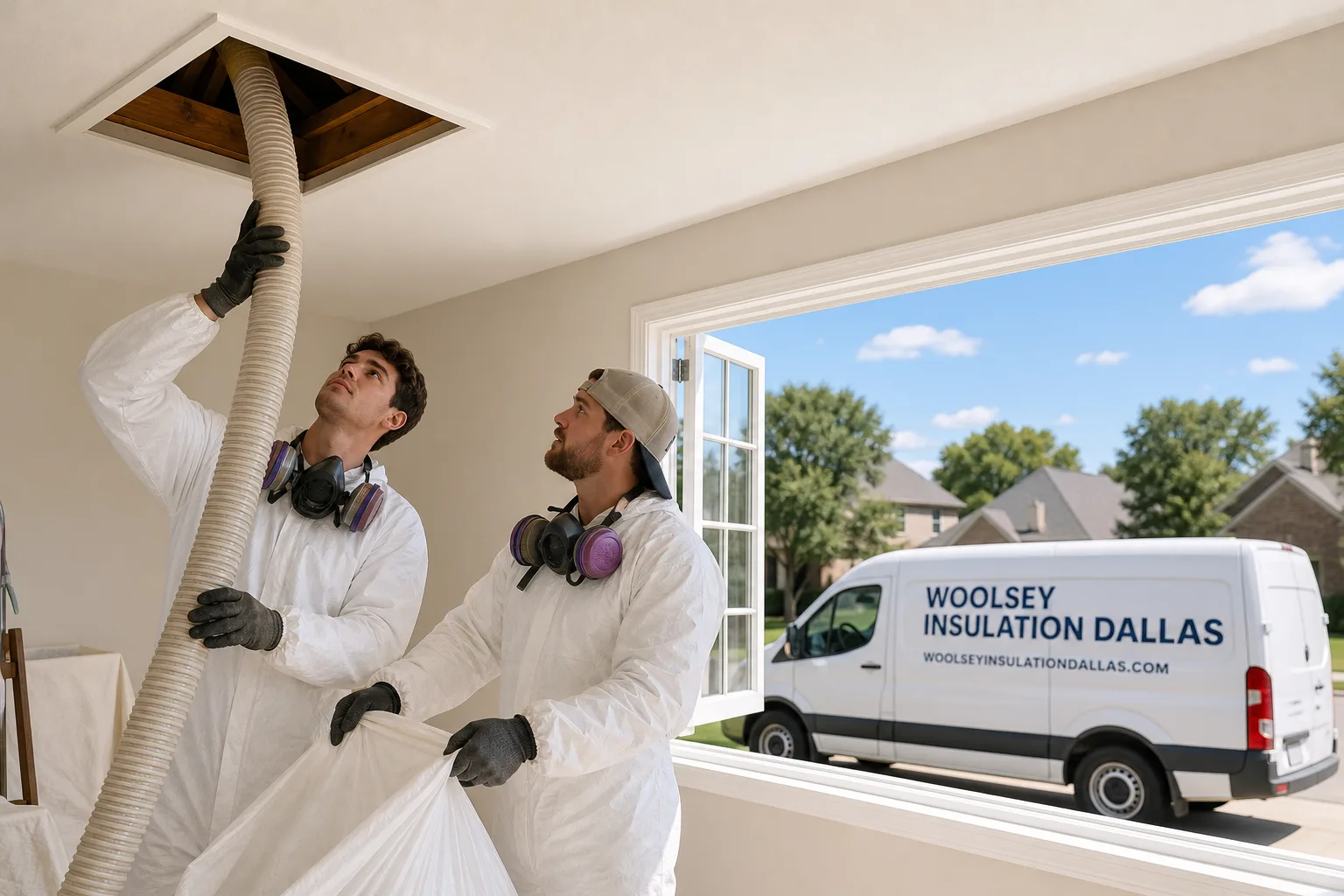
Fast, Reliable Attic Insulation Across Oak Cliff
If your Oak Cliff home was built before 1960, there’s a good chance your attic is working against you. Most bungalows and brick-veneer cottages in Wynnewood, Kiest Park, and Elmwood left the factory with thin or missing insulation, shallow rafter bays, and venting that was never designed for Texas heat. Our Attic Insulation team works across Oak Cliff every week, and we know these houses the way a mechanic knows an old pickup: the quirks, the weak spots, and the fixes that actually hold up. Call (469) 916-4622 and we’ll give you a written price before any work starts.
Here’s what matters: insulation in a 1930s pier-and-beam bungalow isn’t the same job as insulation in a 2010 tract house. The older home needs air sealing first, ventilation second, and insulation third. Skip the first two and you’ve just installed an expensive moisture problem. We’ll walk you through what your specific house needs.
Why Woolsey Insulation Dallas Is Oak Cliff’s Preferred Attic Insulation Company
Woolsey Insulation Dallas has been serving Oak Cliff homeowners long enough to be on a first-name basis with the building styles in every pocket of the neighborhood. Our techs have crawled through attics in Stevens Park bungalows, removed failed blow-in from Kessler Park colonials, and re-insulated ranch homes along West Davis Street. Oak Cliff’s housing stock is specific, and so is the way we approach it.
Glenn Hartley leads the team, and he’s built the operation around something called The Kingswell Way: say the exact price, show up in the committed window, leave the job site cleaner than you found it, put the guarantee in writing, and come back free if anything fails within 365 days. Every tech is background-checked and uniformed, so you know who’s walking through your door. And when you call, a real person answers, 24 hours a day. No voicemail maze. No third-party call center. That matters when you’ve got raccoons in the attic at 2 a.m. or a heat wave coming in three days.
Attic Ventilation in Oak Cliff
Attic Ventilation in Oak Cliff is the correction most older homes need before any new insulation goes in. The long, humid summers with temperatures pushing past 100°F turn a poorly vented attic into an oven that bakes your insulation, warps your roof deck, and forces your AC to fight against heat that never leaves. Most pre-1960 homes here were built with small gable vents or no vents at all, and the shallow 2×4 rafter bays don’t leave much room for airflow.
A proper venting job in an Oak Cliff bungalow typically runs $800 to $1,600 depending on how much soffit venting needs to be added and whether baffles are required in every rafter bay. We quote that number in writing before we touch anything.
Adding baffles to shallow attics
Baffles are the plastic or foam channels that keep insulation from blocking airflow at the eaves. In a 2×4 rafter bay, they’re not optional, they’re the difference between a working attic and a mold factory. We’ve seen dozens of Oak Cliff attics where someone blew insulation directly into the eaves, blocked the only source of air, and caused condensation on the roof deck within two summers.
When to address ventilation before insulation
If your attic has no soffit vents or you’re seeing rust on nails poking through the roof deck, the ventilation needs attention first. It costs less to add proper airflow than it does to tear out moldy drywall or replace a rotted deck. We’ll tell you honestly whether your attic needs venting work or whether the existing system can handle the upgrade.
Radiant Barrier in Oak Cliff
Radiant Barrier in Oak Cliff is a thin, reflective foil installed on the underside of your roof rafters that bounces radiant heat back out before it can soak into your attic and push down through your ceilings. If your attic hits 140°F in July, a radiant barrier can drop it by 20°F or more. That’s a real difference in a house on a tree-lined street in Wynnewood, and it’s an even bigger difference on an exposed corner lot along South Hampton Road.
Installing a radiant barrier in a typical Oak Cliff attic runs $1,200 to $2,400, depending on the roof’s footprint and whether we’re stapling it to the rafters or laying it over existing insulation on the attic floor. Both methods work; the right one depends on your attic’s shape.
Rafter-mounted vs. floor-laid barrier
Stapling to the rafters is the cleaner install where the attic is open and accessible. Laying it over the floor insulation is the right call where the roof pitch is low or the attic is tight, and it still reflects heat while protecting the insulation beneath from dust and degradation. We’ll show you both options and quote them separately.
Pairing with existing insulation
A radiant barrier doesn’t replace insulation, it works alongside it. Think of it as a sunshade for your attic rather than a blanket. In an Oak Cliff home where the cellulose or fiberglass is already adequate, adding the barrier is often the single highest-impact upgrade you can make for the money, especially on the west-facing side of the house that takes the full afternoon sun.
Trusted Brands We Service in Oak Cliff
We work with eight manufacturers, including Owens Corning, Demilec, and GreenFiber, and the material we recommend is chosen for your house’s specific construction, not whatever happens to be on the truck. A 1950s ranch with brick veneer and no sheathing needs a different product than a 1970s split-level with plywood sheathing and a standard vented attic. We stock enough material range to serve Oak Cliff customers without waiting on special orders, and our suppliers run regular deliveries to the Dallas-Fort Worth office so lead times stay short.
Common Attic Insulation Problems We See in Oak Cliff Homes
- Blocked gable vents from careless blow-in jobs. The original vent was small to begin with, and once insulation blocks it, condensate builds on the roof deck and mold follows. We fix this with baffles and proper air channeling before adding anything new.
- Wet floor insulation over pier-and-beam crawlspaces. Without sealed rim joists and controlled ground moisture, insulation installed under the floor becomes a damp sponge after the first freeze-thaw cycle. The original hardwood floors above warp, and the insulation sags and fails.
- No sheathing under brick veneer in pre-1960 walls. The old construction used tar paper over the studs and brick over that. Injection foam installed without accounting for this can trap moisture against the brick in humid weather, which is why the job has to be planned carefully rather than just drilled and filled.
- Knob-and-tube wiring buried under new insulation. In 1920s and 1930s bungalows around Kiest Park and Elmwood, the original wiring is still live. Covering it with insulation creates a fire risk, and the wiring needs to be evaluated and addressed before insulation goes on top.
Pricing for Attic Insulation in Oak Cliff, TX
Here are straight numbers for the Oak Cliff market. A blown-in attic insulation top-up on a 1,200-square-foot bungalow typically runs $1,400 to $2,200. A full attic insulation replacement with air sealing and baffles runs $2,800 to $4,800. Attic ventilation work as described above runs $800 to $1,600, and a radiant barrier runs $1,200 to $2,400. What moves the number is your attic’s accessibility, whether old insulation has to be removed, and whether the walls or rim joists need sealing alongside the attic. We give you the exact written price before any work starts, and that price doesn’t change at the door.
Call (469) 916-4622 for a free estimate. We’ll walk your attic, show you what’s actually there, and hand you a number you can hold us to.
We Also Serve Cities Near Oak Cliff
Our crews dispatch from the Dallas-Fort Worth office and serve homeowners across the metro area, including Attic Insulation customers throughout the region. If you’re in Dallas, Arlington, Garland, or Carrollton, we bring the same Kingswell Guarantee: written pricing, committed arrival windows, clean job sites, and the 365-Day Done Right Promise.
Serving Oak Cliff, TX - Our Local Coverage Area
We’re based in the Oak Cliff area and know this community well. Use the map below to see our service coverage - if you’re nearby, we can almost certainly help.
FAQs About Attic Insulation in Oak Cliff
Yes, we can insulate it even without a standard attic hatch. We cut a clean access opening in a closet ceiling or hallway, perform the work, and leave a properly fitted and trimmed access panel when the job is done. In many Oak Cliff bungalows the “attic” is a shallow space with 2×4 rafters, and we’ve insulated hundreds of them this way. Call (469) 916-4622 and we’ll tell you what’s possible in your specific house.
Yes. Original knob-and-tube wiring from the 1920s and 1930s should not be covered with insulation. The wires were designed to dissipate heat into open air, and burying them under cellulose or fiberglass creates a fire risk. We’ll identify active knob-and-tube during the estimate, and in many cases insulation can be added safely in areas where the wiring is not present or where it’s been properly decommissioned. The evaluation is free, and we’ll tell you plainly what you’re working with.
Because the heat isn’t only coming from the attic. In a pier-and-beam home, the crawlspace acts as a heat reservoir in summer, and if the rim joists were never sealed, hot air rises through the walls and into the upper floor. If your home has original brick veneer with no sheathing, the wall cavities are also leaking air continuously. The fix is sealing the rim joists and wall top plates, then adding insulation where it was never installed. Attic insulation alone can’t correct a leaky envelope.
The answer depends on whether the wall has sheathing under the brick. Many 1950s brick-veneer homes in Oak Cliff were built with tar paper over the studs and no plywood or OSB sheathing. Injection foam can be installed in these walls, but it must be done with a non-expanding or low-expansion product applied in controlled lifts, and only after the wall’s drainage plane is evaluated, or moisture can be trapped against the brick. We’ll inspect the wall construction from the attic and crawlspace and recommend the right approach, not just the easiest one.
Yes, in most Oak Cliff homes it is worth it. Cellulose slows conductive heat, but a radiant barrier reflects the bulk of the radiant heat that enters the attic before it ever reaches the insulation. It’s a different mechanism, and it complements rather than replaces your existing insulation. For a west-facing house with a dark shingle roof, we routinely see attic temperature drops of 20°F or more. If you’re not sure whether your attic is a good candidate, call us and we’ll give you an honest read.
We answer the phone live, 24/7. Call (469) 916-4622 for a free estimate in Oak Cliff, or to schedule an attic inspection. Glenn Hartley’s team will show up on time, give you a written price, and stand behind the work for 365 days, in writing.
Written by Glenn Hartley, Owner at Woolsey Insulation Dallas, serving Oak Cliff and the Dallas-Fort Worth area since 2002.