
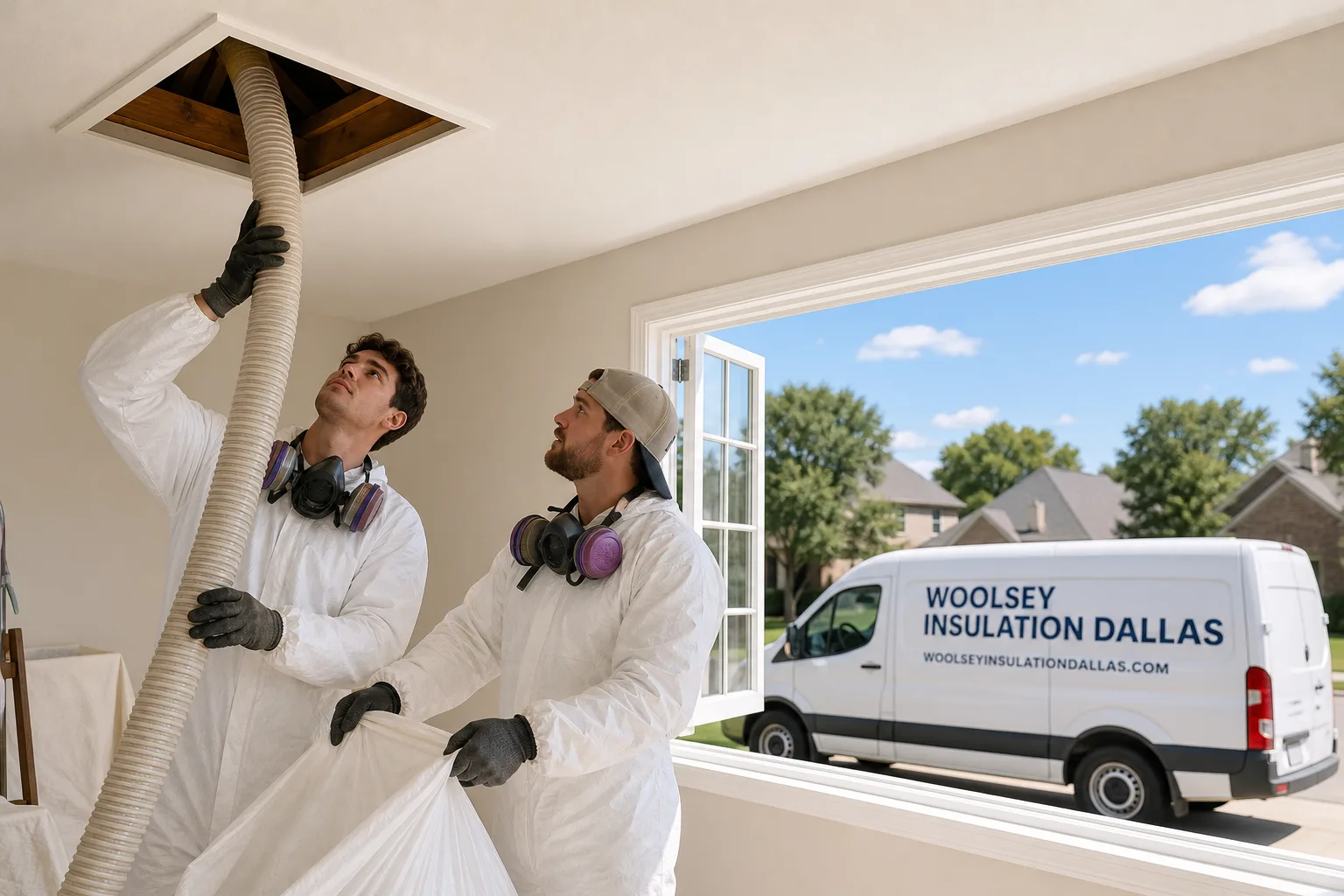
Fast, Reliable Spray Foam Insulation Across Balch Springs
Spray foam insulation in Balch Springs typically runs $3.50 to $7.00 per board foot depending on whether you need open-cell or closed-cell, and most attic jobs land between $4,800 and $9,500 all-in. We get crews out to Balch Springs fast, usually within one to two business days, and every job starts with a written price before any work begins. If you’ve got a 1970s ranch with a hot attic or a detached workshop that turns into an oven by mid-morning, you know exactly what we’re talking about. Call (469) 916-4622 and a live person will answer, day or night.
We’ve spent a lot of time in Balch Springs, from the neighborhoods off Lake June Road to the acreage lots along Hickory Creek Road and Belt Line. The homes here have their own rhythm and their own problems. We know them well. And we’ve got the fix.
Why Woolsey Insulation Dallas Is Balch Springs’s Preferred Spray Foam Insulation Company
Homeowners across Balch Springs call us for one reason that keeps repeating: we show up when we say we will, and the price we quote is the price you pay. Founded in 2002 under the Kingswell banner, Woolsey Insulation Dallas is independently owned and operated, with Glenn Hartley at the helm. Every technician who walks into your Balch Springs home is background-checked and uniformed. You’ll know exactly who’s at your door before you open it.
Our 365-Day Done Right Promise covers every spray foam job we do in Balch Springs. If it’s not right within a year, we come back and fix it at no charge. In writing. No fine print, no phone tag. That’s the Kingswell Way: say the price, show up in the window, leave the site cleaner than you found it, put the guarantee on paper, and come back if it fails. We answer the phone 24/7 with a live person, not a voicemail maze.
Local crews know the streets here. When you call from a cul-de-sac off Seagoville Road or a long driveway near the eastern edge of town, we don’t need directions explained twice.
Crawl Space Spray Foam Insulation in Balch Springs
Crawl Space Spray Foam Insulation in Balch Springs addresses a problem many homeowners don’t realize they have until the floor gets cold in January or the electric bill spikes in July. Many homes here sit on slab foundations, but a good number of older properties, especially those built on slightly sloped lots, have vented crawl spaces that pull in humid Texas air year-round. Closed-cell spray foam applied to the crawl space walls seals those vents and stops moisture before it reaches your floor joists. Costs for a typical crawl space encapsulation in Balch Springs run $6,000 to $12,000 depending on square footage and access.
The payoff shows up fast. You get warmer floors in the winter, cooler floors in the summer, and a noticeable drop in humidity inside the house. Rodents and bugs lose their highway, too.
Sealing the Crawl Space Envelope
We apply closed-cell foam to the perimeter walls and rim joists, not the floor above. This keeps the crawl space inside your home’s thermal boundary. The foam acts as both insulation and air barrier in one shot.
Moisture Control First
Before foam goes in, we check for standing water, drainage issues, and ground moisture. Foam over a wet crawl space makes things worse. We’d rather tell you the truth than sell you a problem.
Garage Spray Foam Insulation in Balch Springs
Garage Spray Foam Insulation in Balch Springs is one of the most common requests we get, especially from homeowners with attached garages that bake in the afternoon sun. A typical two-car garage runs $2,800 to $5,500 to insulate the ceiling and shared wall with closed-cell foam. It makes an immediate difference: the garage stays 15 to 20 degrees cooler in August, and the room above it stops feeling like an attic.
For detached garages and workshops, which are everywhere on the acreage lots around Balch Springs, the scope changes. Those structures usually have no insulation at all. Spray foam is often the only practical option because it conforms to metal framing and roof decking without needing a full build-out.
Attached Garage Ceilings
We spray the ceiling and the wall shared with the house. That’s where the heat comes through. The exterior walls can wait, but the ceiling is the priority in this climate.
Detached Workshop Roof Decks
On metal buildings, we apply foam directly to the underside of the roof deck. This seals the ridge, eaves, and every screw hole that leaks air. No fiberglass batt can do that on a corrugated metal panel.
Trusted Brands We Service in Balch Springs
We work with eight leading insulation brands: Owens Corning, Johns Manville, Knauf, Rockwool, CertainTeed, Icynene, Demilec, and GreenFiber. For spray foam work in Balch Springs, we most often reach for Icynene and Demilec closed-cell products, and CertainTeed for open-cell. The material choice follows the building, not whatever happens to be on the truck. A 1970s ranch attic with low-pitched eaves gets a different spec than a detached metal workshop. That’s the point of carrying multiple lines. We keep a full stock of the materials Balch Springs jobs actually need, so turnaround stays tight.
Wool was the first insulation. Woolsey keeps the idea in the name, and our Spray Foam Insulation team takes that legacy seriously on every Balch Springs job.
Common Spray Foam Insulation Problems We See in Balch Springs Homes
- Settled fiberglass batts under new spray foam. Contractors sometimes spray right over the old R-11 batts in 1970s ranch attics. The foam traps moisture against the original sheathing, and rot follows along the low-pitched roof edges. The old insulation has to come out first, no shortcuts.
- DIY foam kits on metal workshop walls. Homeowners buy a kit at the hardware store, apply it to detached workshop walls without a vapor barrier, and within two seasons the metal siding is rusting and the paint is peeling. Closed-cell foam done right acts as its own vapor barrier. Done wrong, it’s a moisture trap.
- Open-cell foam in vented split-level attics. Open-cell is a great product in the right place. In a vented attic on a split-level built in the 1980s, it pulls humid outside air through the foam, which kills the R-value and leaves a musty smell. That attic needs closed-cell or a sealed-attic conversion.
- Ignored rim joists on slab homes. The attic gets all the attention, but the rim joist where the wall meets the slab is a major air leak in Balch Springs ranch homes. Spraying the rim joists with closed-cell foam makes a bigger comfort difference than most people expect.
Pricing for Spray Foam Insulation in Balch Springs, TX
Here’s what you can expect to pay in the Balch Springs market. Open-cell spray foam runs $1.80 to $3.00 per board foot; closed-cell runs $3.50 to $7.00 per board foot. A full attic retrofit on a 1,400-square-foot 1970s ranch typically lands between $6,500 and $11,000 after the old batts are removed. Garage ceilings run $2,800 to $5,500. Crawl space work runs $6,000 to $12,000. Rim joist sealing runs $1,500 to $3,500 depending on access.
You’ll get the exact written number before anything starts. That’s not a sales tactic, it’s the Kingswell Guarantee. Free estimates, no door-step surprises, and the price on paper is the price you pay. Call (469) 916-4622 for a quote.
We Also Serve Cities Near Balch Springs
Our crews cover Balch Springs and the surrounding communities, including Seagoville, Dallas, Rowlett, and Garland. If you’re just outside city limits or on a county road between them, call us. We’ll tell you straight if we can get a crew to you in the window you need. For a full look at our local coverage, see Spray Foam Insulation in Balch Springs and the surrounding area.
Serving Balch Springs, TX - Our Local Coverage Area
We’re based in the Balch Springs area and know this community well. Use the map below to see our service coverage - if you’re nearby, we can almost certainly help.
FAQs About Spray Foam Insulation in Balch Springs
It depends on the metal panel manufacturer, but most major brands honor their warranties when closed-cell spray foam is applied by a licensed professional to the underside of the roof deck. The key is proper surface preparation and correct foam thickness. We’ve done many of these on Hickory Creek Road and around the acreage lots, and we’ll document the application so you have a record if a warranty claim ever comes up. Call (469) 916-4622 and we’ll walk you through what your metal roof needs.
Condensation on interior walls after an attic spray foam job usually means the home’s airflow balance was thrown off without addressing the slab perimeter. These 1970s ranches were built leaky on purpose; seal the attic too tight without sealing the rim joists and crawl openings, and humid air gets trapped against the slab, not the walls. The fix is a full air-sealing package, not just the attic. That’s why we always look at the whole envelope before we start.
Closed-cell spray foam can dramatically reduce wind-driven air infiltration through the roof deck and wall plates, which is exactly what happens during severe storms in the Dallas-Fort Worth tornado corridor. It’s not a structural retrofit, so don’t mistake it for a tornado shelter upgrade. But sealing the attic and rim joists with closed-cell foam keeps wind-blown rain and debris from pressurizing the building envelope. For a 1980s split-level, that’s a real comfort and durability upgrade. Call us at (469) 916-4622 to talk through your roof deck.
A 1970s attic with original R-11 batts that have settled to around R-8 is a poor performer either way, but spray foam and blown-in fiberglass solve different problems. Blown-in is cheaper, usually $1,800 to $3,500 for that attic, and it raises the R-value. Spray foam costs more, typically $6,500 to $11,000, but it also air-seals the ceiling plane, which fiberglass does not. If the home is drafty and the AC runs nonstop in July, air sealing is the bigger win. If the budget is tight, blown-in is still far better than doing nothing. We’ll give you honest numbers for both, in writing, before you decide.
Closed-cell spray foam is safe for that garage once it’s fully cured, which takes about 24 hours. During installation, the two-part chemical reaction produces fumes that require ventilation and appropriate respiratory protection. The bigger safety consideration is the car itself: open fuel lines mean fuel vapors are present, so no ignition source can be anywhere near the install area during application. We shut down, ventilate, and clear the space before we start. If your classic car is the reason you’re insulating, tell us upfront so we plan the job around it. Call (469) 916-4622 and we’ll come take a look.
Written by Glenn Hartley, Owner at Woolsey Insulation Dallas, serving Balch Springs under the Kingswell Guarantee.